

There’s a meeting happening right now in a boardroom somewhere. A CEO is presenting a “digital transformation initiative.” The slides have all the right buzzwords — AI, automation, data-driven, intelligent operations. There’s a budget. There’s enthusiasm. There’s a timeline.
Eighteen months later, the project is quietly shelved. The pilot worked. The vendor demos were impressive. But nothing actually changed the way the business operates.
I’ve watched this play out more times than I’d like to count. Not because the technology failed — the technology almost never fails. It fails because companies confuse digital transformation with software purchasing. They buy AI tools and call it a strategy.
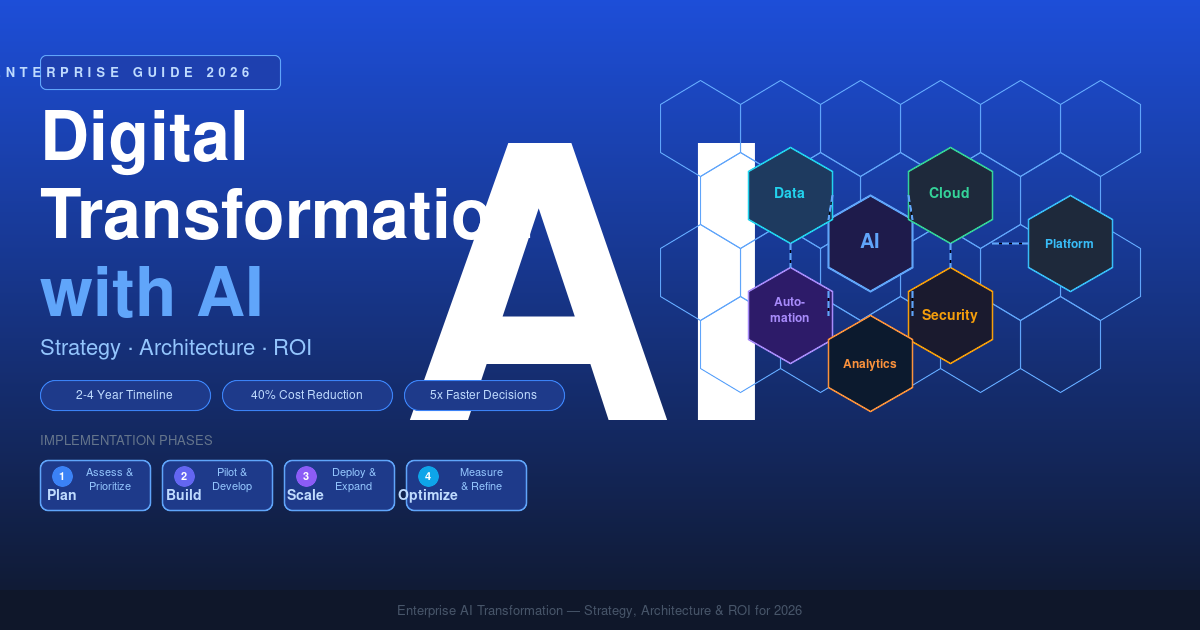
Genuine digital transformation with AI isn’t about the tools. It’s about fundamentally rethinking how your organization creates value, makes decisions, serves customers, and competes — using AI as the enabling layer. The tools are just the implementation.
The companies that get this right aren’t necessarily the ones with the biggest budgets. They’re the ones that started with the right questions. This guide is about those questions, and the answers that actually move the needle.
Table of Contents
- What Digital Transformation with AI Actually Means in 2026
- The Real Business Problems AI Transformation Solves
- How AI Changes the Transformation Equation
- Industry Use Cases That Are Actually Working
- Building Your AI Transformation Architecture
- Practical Implementation: Where to Start and Why
- The Cost Reality: Budgeting for AI Transformation
- Security, Privacy and Governance You Cannot Skip
- Benefits — The Honest Version
- Risks and Limitations Nobody Puts in the Brochure
- The Human Problem: Change Management in AI Transformation
- Common Mistakes That Kill AI Transformation Programs
- Best Practices from Transformations That Succeeded
- Step-by-Step Adoption Guide for 2026
- Future Trends: Where AI Transformation Heads Next
- Expert Recommendations by Role
- Frequently Asked Questions
- Final Thoughts
What Digital Transformation with AI Actually Means in 2026
Digital transformation has been a business priority for over a decade. Cloud adoption, mobile-first experiences, e-commerce migrations, ERP modernization — these were the defining initiatives of the 2010s and early 2020s. Most enterprises have completed at least some version of that journey.
What’s happening now is different. AI doesn’t just digitize existing processes. It fundamentally changes what processes are possible.
Think about it this way. Traditional digital transformation moved a paper-based invoice approval process into an ERP system. The process was the same — a human reviewed the invoice, checked it against a purchase order, and approved or rejected it. The workflow was digital, but the intelligence was still human.
AI transformation means the system reviews the invoice, cross-references it against purchase orders, flags anomalies, detects potential fraud patterns, routes exceptions to the right approver, and learns continuously from approval decisions. The human is now in the loop only when something genuinely needs human judgment.
That’s not a subtle difference. That’s a different operating model.
In 2026, AI transformation has three defining characteristics:
- Intelligence is embedded in workflows, not bolted on as a reporting layer
- Decisions are increasingly automated at the operational level, with humans handling exceptions and strategy
- Systems learn and adapt — they get better at their jobs over time without being reprogrammed
The organizations that understand this distinction are pulling significantly ahead of those still treating AI as a feature to add to existing software.
The Real Business Problems AI Transformation Solves
Here’s where companies often struggle: they begin with technology and work backward to find problems it solves. The smarter approach is the opposite — start with the business pain, then evaluate whether AI is genuinely the right solution.
From working across manufacturing, financial services, healthcare, retail and professional services firms, the same categories of problems appear repeatedly.
Decision Latency
Most business decisions take far longer than they should. Not because humans are slow — but because the information needed to make a good decision is scattered across systems, formats and departments. A pricing decision that should take five minutes takes five days because someone has to pull data from three systems, create a spreadsheet, and get it in front of the right person.
AI collapses that timeline. Systems that continuously monitor relevant signals and surface actionable recommendations eliminate the data assembly problem entirely. A pricing engine backed by machine learning can adjust prices dynamically in real time — something no human team can match at scale.
Operational Inefficiency at Volume
There are entire categories of work that are genuinely not worth paying human attention to — not because the work isn’t important, but because it’s high-volume, repetitive, and rule-bound. Invoice processing. Tier-1 customer support. Quality inspection in manufacturing. Document classification. Data entry between systems.
These tasks are perfect for AI automation. They’re clearly defined, measurable, and generate enormous labor costs at scale. One important thing many people overlook: the business case for automating these tasks isn’t just cost reduction. It’s also accuracy, speed and the ability to redeploy skilled people on work that actually requires their intelligence.
Customer Experience Personalization at Scale
Personalization has been a marketing goal for 20 years. For most of that time, it meant segmenting customers into groups and showing each group slightly different content. Real personalization — treating each customer as an individual, predicting what they need before they ask, adapting the experience in real time — wasn’t economically possible at scale without AI.
Now it is. And customers increasingly expect it. A B2B software company that sends the same onboarding email sequence to every new user is leaving significant retention improvement on the table.
Knowledge Management and Institutional Memory
This one rarely makes it into digital transformation proposals, but it may be the most underrated AI opportunity in most organizations. Companies lose enormous value when experienced employees leave — decades of judgment, pattern recognition, and contextual knowledge walks out the door with them.
AI systems trained on an organization’s data, documents, communications and outcomes can begin to encode that institutional knowledge. The enterprise knowledge assistant that can answer “what did we bid on the Henderson account in 2019 and what was the outcome?” from natural language is genuinely valuable, and the technology to build it exists today.
How AI Changes the Transformation Equation
Previous waves of digital transformation had clear success metrics: go-live date, user adoption rate, cost savings from eliminating paper. AI transformation is more complex to measure and more difficult to manage because the technology doesn’t stand still.
Three fundamental differences from traditional digital transformation:
1. AI systems improve over time. A traditional ERP implementation is essentially static — it does what it was configured to do. An AI system trained on your customer data gets better at predicting customer behavior as it processes more interactions. This creates compounding value over time, but also introduces new management challenges.
2. The ROI curve is different. Traditional software investments often show quick initial returns before plateauing. AI investments often show modest early returns that grow significantly as models mature, data accumulates, and use cases expand. This mismatch between expectation and reality is one of the leading causes of AI project abandonment.
3. Integration complexity is fundamentally higher. Integrating an AI prediction system into operational workflows — where its outputs need to reach the right people, trigger the right actions, and be monitored for quality — is a different level of complexity entirely from standard software integration.
Expert Note: The organizations most successful with AI transformation treat it as capability-building rather than project delivery. They’re not asking “how do we complete this AI implementation?” They’re asking “how do we build an organization that is continuously better at using AI?”
Industry Use Cases That Are Actually Working

Financial Services: Credit Risk and Fraud Detection
Banks and insurance companies were among the earliest serious AI adopters, largely because their data is structured, their decision rules are explicit, and the ROI of better decisions is immediately quantifiable.
JPMorgan Chase’s COiN (Contract Intelligence) platform processes in seconds what previously took legal teams 360,000 hours annually. ING Bank uses machine learning models for credit scoring that process thousands of data signals beyond traditional credit bureau data, identifying creditworthy customers that traditional models would decline.
Fraud detection is perhaps the clearest AI success story in financial services. Real-time transaction scoring systems analyze hundreds of variables per transaction in milliseconds. Mastercard’s Decision Intelligence platform and Visa’s Advanced Authorization process billions of transactions and save billions in fraud losses annually.
Manufacturing: Predictive Maintenance and Quality Control
In enterprise environments, unplanned equipment downtime is extraordinarily expensive. Predictive maintenance AI — which analyzes sensor data from equipment to predict failures before they occur — is one of the most proven industrial AI applications. Siemens, GE Digital and Honeywell all have deployed platforms generating documented ROI. Rolls-Royce monitors its aircraft engines in flight in real time, continuously analyzing performance data to predict when maintenance is needed.
Computer vision quality inspection is equally compelling. AI systems that inspect products on production lines at speeds and with consistency that human inspectors cannot match are now standard in semiconductor manufacturing, pharmaceutical packaging, food processing and automotive assembly.
Retail: Supply Chain Intelligence and Customer Experience
Amazon’s recommendation engine reportedly drives 35% of total revenue. Outside Amazon, retailers implementing AI demand forecasting are seeing inventory carrying cost reductions of 20–35% and stockout reductions of 40–60%. Starbucks’ “Deep Brew” AI platform personalizes mobile app experiences for millions of customers daily while also handling labor scheduling and equipment maintenance prediction.
Professional Services: Document Intelligence and Research
Harvey, Casetext and similar legal AI platforms enable junior associates to complete due diligence reviews that previously required senior partner time — reducing time needed for routine analysis by 60–80%, without replacing attorneys.
Building Your AI Transformation Architecture

One thing I’ve noticed in organizations that stall on AI transformation: they try to make individual AI decisions without a coherent architecture. They buy a chatbot here, implement an analytics tool there, pilot a prediction model somewhere else — and end up with a disconnected collection of experiments that never compounds into organizational capability.
Data Foundation
Every AI capability sits on data. If your data is siloed, inconsistent, incomplete or ungoverned, your AI capabilities will reflect that. There are no shortcuts here. Minimum requirements: a unified data platform (cloud data warehouse or lakehouse), consistent master data management for core entities, and data quality monitoring.
ML Platform and Model Management
Where do your AI models live? How are they deployed? How is their performance monitored? Modern ML platforms — Databricks, Azure Machine Learning, AWS SageMaker, Google Vertex AI — provide the infrastructure for training, deploying, monitoring and governing AI models at scale. For most organizations, building this infrastructure from scratch makes no sense.
Integration and Workflow Layer
AI insights are worthless if they don’t reach the people and systems that need them at the moment of decision. A demand forecast that generates accurate predictions but lives in a dashboard nobody checks isn’t driving transformation. The same forecast integrated into procurement workflows, automatically generating purchase orders for review, is. The technology is identical. The integration is completely different.
Governance and Trust Framework
Who approves AI use cases? How are models validated before deployment? How are bias risks assessed? What happens when a model makes a clearly wrong decision? These questions need answers before you deploy anything. Without a governance framework, AI transformation either stalls — or moves too fast and creates incidents that set back organizational trust.
Practical Implementation: Where to Start and Why
The most common question from organizations beginning AI transformation isn’t technical. It’s “where do we start?”
Start with a business problem that has three characteristics:
- It’s measurable. You can define what success looks like in numbers before you begin.
- It’s meaningful. The problem matters to someone senior in the organization — this ensures resources and air cover when implementation challenges arise.
- It’s achievable with available data. You don’t need perfect data — but you need data.
Practical starting points that work across most organizations:
- Intelligent document processing: High volume, rule-adjacent tasks, immediate ROI, low regulatory risk
- Predictive customer churn: Clear business value, usually good existing data, fast to prototype
- AI-enhanced internal search: High employee value, relatively low risk, builds AI familiarity
- Demand forecasting: Strong data typically exists, clear business metrics, measurable ROI
The Cost Reality: Budgeting for AI Transformation

This is where most business cases are either naively optimistic or deliberately vague. Let me be direct about what AI transformation actually costs.
The Four Cost Categories Nobody Fully Budgets
1. Data infrastructure and preparation (often 30–40% of total project cost). Getting data into the right shape for AI is rarely quick or cheap. Legacy system data extractions, data cleaning, feature engineering — these are labor-intensive activities that vendors consistently underestimate.
2. Integration and deployment (often 20–30% of total cost). Getting a model from a notebook to a production system that runs reliably and integrates with existing tools is genuinely complex engineering work.
3. Change management and training (often underinvested at 10–15% of budget). Deploying AI without appropriate training and change management is one of the most reliable ways to fail.
4. Ongoing operations and monitoring (recurring cost, often ignored). Budget 15–20% of initial build cost annually for operations, monitoring and retraining.
Realistic Cost Ranges by Scope
| Initiative Type | Typical Budget Range | Timeline |
|---|---|---|
| Single AI use case (vendor solution) | $50K – $300K | 3–6 months |
| Single AI use case (custom built) | $200K – $1M | 6–12 months |
| Departmental AI transformation | $500K – $3M | 12–18 months |
| Enterprise-wide AI transformation | $5M – $50M+ | 2–5 years |
| AI platform and data foundation | $1M – $10M | 12–24 months |
⚠ Warning: Be skeptical of any AI transformation proposal that promises significant ROI within 90 days. Genuine transformation takes longer. Quick wins are possible and worth pursuing — but confusing a quick win with transformation is a strategic error.
Security, Privacy and Governance You Cannot Skip
Data Privacy in AI Systems
AI systems typically require large volumes of data for training and operation. When that data includes personally identifiable information or sensitive business data, privacy risk is significant. Critical controls: data minimization, anonymization where feasible, clear data retention policies, and geographic data residency controls where regulations require it (GDPR, PDPA, CCPA).
AI-Specific Security Threats
Beyond standard application security, AI systems face specific threat categories:
- Model poisoning: Adversarial data introduced during training to corrupt model behavior
- Adversarial examples: Inputs deliberately crafted to fool AI systems
- Model extraction: Competitors querying your AI systems to reverse-engineer your underlying model
- Prompt injection: For LLM-based systems, crafted inputs that override system instructions
Governance Frameworks That Actually Work
At minimum, mature AI governance includes: an AI use case registry, pre-deployment risk assessment, defined model performance standards, bias and fairness testing protocols, clear human override procedures, incident response procedures, and regular governance reviews.
Benefits — The Honest Version
| Benefit | Realistic Range | What Drives Variance |
|---|---|---|
| Operational cost reduction | 15–45% for automated processes | Baseline automation level, process complexity |
| Decision speed improvement | 60–90% faster for defined decisions | Current process maturity, integration quality |
| Forecast accuracy improvement | 15–35% over baseline | Data quality, model sophistication |
| Customer satisfaction improvement | 10–25% lift | Personalization depth, touchpoint coverage |
| Employee productivity (knowledge work) | 20–40% improvement | Tool adoption, workflow integration |
Cost reduction benefits materialize faster and are easier to measure. Revenue benefits take longer and are harder to attribute cleanly to AI. Most business cases rely too heavily on revenue projections and undervalue the operational savings that are more reliably achievable.
Risks and Limitations Nobody Puts in the Brochure
The Data Reality Check
If your data quality is poor, AI will automate poor decisions faster. I’ve genuinely watched this happen. A sales forecasting model trained on data that excluded canceled orders generated forecasts that were systematically optimistic. The model wasn’t wrong — the data was.
The Model Confidence Problem
AI systems produce outputs with confidence scores, but those confidence scores don’t always mean what users assume. A model that is 92% confident can be wrong 8% of the time — and in high-volume automated systems, that 8% represents a significant number of real errors.
Vendor Lock-in Risk
Enterprise AI platforms are not commodities. Migrating from one ML platform to another is genuinely painful. Make vendor selection decisions with long-term dependency risks explicitly considered.
The Skills Gap Is Real
The global shortage of AI and data engineering talent isn’t improving as fast as demand is growing. Building and maintaining AI capabilities requires data scientists, ML engineers, AI architects and data engineers who are expensive, hard to hire, and frequently recruited away.
The Human Problem: Change Management in AI Transformation
This section matters more than most AI articles acknowledge. Technology is the easy part. People are harder.
The resistance patterns I see most frequently:
Fear of replacement. Employees who believe AI will cost them their jobs are not going to enthusiastically adopt AI tools. Addressing this explicitly and honestly is necessary. Vague reassurances that “AI will create new jobs” are not sufficient.
Trust deficits. Employees who’ve been burned by previous technology rollouts approach new systems with justified skepticism. Building trust requires AI systems that demonstrably work before asking people to rely on them.
Skill anxiety. Not everyone is comfortable with data-driven decision-making or interpreting AI outputs. Providing genuine training — not checkbox compliance training — is essential.
The smarter approach is to involve frontline employees in AI design early. The people who actually do the work understand its nuances in ways that technology teams and consultants don’t. Their input makes AI implementations better, and their involvement creates ownership rather than resistance.
Expert Note: In every successful AI transformation I’ve observed, there were identifiable “champions” at the operational level — frontline employees who believed in the initiative and helped their colleagues adapt. Finding and empowering these people is as important as any technical decision.
Common Mistakes That Kill AI Transformation Programs
- Starting with technology rather than business problems. Buying an AI platform and then searching for use cases is working backwards.
- Pilot paralysis. Running pilots indefinitely without a defined path to production delivers essentially no value.
- Underestimating data work. Every AI project takes longer than expected because data is worse than expected. Build 50% more time for data preparation than your initial estimate.
- Treating AI governance as a compliance checkbox. Organizations that do the minimum required governance eventually have an AI incident that sets back organizational trust.
- Hiring AI talent without a plan to retain them. Losing key AI talent mid-transformation is expensive and demoralizing.
- Building when buying makes more sense. Custom-built AI is appropriate for capabilities core to your competitive differentiation. For commodity capabilities, commercial solutions are almost always faster, cheaper and more reliable.
- Ignoring explainability requirements. Especially in regulated industries, AI systems that can’t explain their decisions create regulatory and ethical risk.
Best Practices from Transformations That Succeeded
- Establish AI leadership with authority. Successful AI transformations have a clear owner with budget authority, executive access, and accountability for outcomes.
- Build a Center of Excellence early. A small internal team of AI practitioners who support business units is worth far more than equivalent investment in one-off project teams.
- Define clear success criteria before every project begins. Without this, you can’t objectively evaluate outcomes or make rational scaling decisions.
- Invest in AI literacy broadly. Business leaders, project managers and frontline employees who understand AI basics make much better decisions about adopting and using AI tools.
- Monitor production AI continuously. Any model in production should have automated performance monitoring with defined thresholds that trigger review and potential retraining.
- Build feedback loops into every AI system. AI systems that incorporate human feedback improve over time. Systems deployed without feedback mechanisms don’t.
Step-by-Step Adoption Guide for 2026

Step 1: Run an Honest Organizational Assessment (Weeks 1–4)
Before committing budget, assess your current state honestly: data maturity, technical capability, organizational readiness, and process maturity. Gaps identified here shape your roadmap. Trying to implement advanced AI on a weak data foundation is like building a skyscraper on sand.
Step 2: Identify and Prioritize Use Cases (Weeks 4–8)
Work with business unit leaders to identify AI opportunities. For each, assess business value, feasibility, and organizational readiness. A simple 2×2 matrix of Value vs Feasibility will surface your best starting points.
Step 3: Build Your Governance Foundation (Weeks 6–10, parallel)
Don’t wait to establish governance. Define your AI approval process, risk assessment framework, monitoring standards and incident response procedures before your first deployment.
Step 4: Launch a Well-Scoped Pilot (Months 2–5)
Select your highest-priority use case and implement a real pilot — not a demo, not a proof of concept, but a working system deployed to a real user group with real measurement. Set a clear 90-day evaluation gate.
Step 5: Evaluate Ruthlessly and Decide (Month 5–6)
Did the pilot hit its success criteria? If yes — what is the path to full deployment and scale? If no — why not? This decision point is where organizational honesty matters most.
Step 6: Scale What Works, Kill What Doesn’t (Months 6–18)
Successful pilots should have a defined scaling plan. Failed pilots should be shut down without drama — learning from failure is valuable; persisting with failure is not.
Step 7: Build Continuous AI Capability (Ongoing)
The most successful organizations don’t treat AI transformation as a project with an end date. They build ongoing capabilities: a team that continuously identifies new use cases, manages deployed models, builds AI literacy across the organization, and stays current with technology developments.
Future Trends: Where AI Transformation Heads Next
Agentic AI Systems
The next significant shift in enterprise AI isn’t better predictions — it’s autonomous agents. AI systems that don’t just analyze and recommend, but take sequences of actions toward defined goals, are moving from research to enterprise deployment. Early versions are being built today.
Multimodal AI in Enterprise Operations
Current enterprise AI mostly handles one data type at a time. Multimodal systems that simultaneously process text, images, audio, video and structured data are becoming commercially viable — delivering far richer analysis than any single-modality system allows.
AI-Native Business Models
The most disruptive competitive dynamic isn’t AI-enhanced traditional businesses — it’s AI-native companies building business models that simply weren’t possible before AI. Traditional competitors often can’t match these companies on cost, speed or personalization because the gap isn’t a technology gap — it’s an organizational design gap.
Increasingly Affordable Foundation Models
The cost of frontier AI capability is falling dramatically. The compute cost to run a capable language model dropped roughly 100x between 2022 and 2025. Competitive advantage increasingly comes from implementation quality, organizational adoption and data assets — not from access to technology.
Expert Recommendations by Role
For CEOs and Business Owners
AI transformation is a strategic imperative, not an IT project. Get personally involved in defining the business problems you’re solving. The organizations winning with AI have leadership that understands the technology well enough to ask good questions.
For CTOs and Technology Leaders
Resist the temptation to build everything custom. Invest deeply in integration capability and ML operations — these are where AI investments succeed or fail in practice.
For CFOs
Push for honest total cost of ownership including data infrastructure, integration, change management and ongoing operations. Insist on defined measurement frameworks before approving AI investments.
For Software Developers and Engineers
The skills most valuable in AI transformation are data engineering, systems integration, MLOps and application development around AI APIs. Understanding how to build reliable, maintainable production AI systems is more valuable than theoretical machine learning expertise for most enterprise roles.
For Digital Transformation Leaders
Your biggest challenges are organizational, not technical. Invest in change management infrastructure as seriously as technical infrastructure. Be ruthlessly honest about what’s working and what isn’t.
Frequently Asked Questions
How is AI-driven digital transformation different from traditional digital transformation?
Traditional digital transformation digitized existing processes — moving paper-based workflows online, centralizing data in ERP systems. AI transformation goes further by embedding intelligence into those processes — automating decisions, predicting outcomes, personalizing experiences at scale, and building systems that improve continuously. The difference isn’t evolutionary; it’s architectural.
How long does a real AI transformation take?
Honest answer: meaningful transformation takes 2–4 years. Individual AI use cases can deliver value in 3–6 months. But transforming how an organization operates — embedding AI into core workflows, building organizational AI capability, shifting decision-making culture — is a multi-year program. Be suspicious of anyone who tells you otherwise.
What AI skills does my team need to develop?
Prioritize in this order: data literacy (for everyone), data engineering (for technical teams), ML engineering and MLOps (for AI developers), and AI product management. Classical data science and model building skills are important but often overemphasized relative to the engineering and operational skills that determine whether AI actually gets deployed.
Should we build AI or buy it?
Build when the AI capability is genuinely differentiating — when your proprietary data or domain expertise creates an advantage that commercial solutions can’t replicate. Buy when you’re solving a problem others have already solved well. Most organizations should be buying much more than they’re building.
How do we measure ROI on AI transformation?
Measure before-and-after on specific operational metrics tied to each use case: transaction processing time, error rates, customer satisfaction scores, forecast accuracy, revenue per customer. Also measure adoption — models that aren’t being used by the people they’re designed for aren’t generating ROI regardless of technical performance.
How do we handle employee resistance to AI?
Directly and honestly. Acknowledge legitimate concerns. Share realistic plans for how roles will evolve. Involve frontline employees in AI design. Provide meaningful training. Identify and empower internal champions. Demonstrate early wins that show AI making employees’ jobs better rather than eliminating them.
What’s the biggest mistake companies make in AI transformation?
Starting with technology rather than business problems. Organizations that buy AI platforms first and then search for use cases consistently underperform those that identify their highest-value business problems first. The technology is the implementation of the strategy — not the strategy itself.
Final Thoughts
Digital transformation with AI isn’t a destination. There isn’t a point at which you’re “done.” The organizations that understand this — that treat AI capability as something you build and refine continuously rather than a project you complete — are the ones pulling ahead of their industries.
The technology has never been more capable or more accessible. The remaining barriers are organizational: clear strategy, quality data, skilled people, genuine governance, and the organizational will to change how work actually gets done.
One more thing worth saying plainly: AI transformation requires honesty. Honesty about what the technology can and can’t do. Honesty about the state of your data. Honesty about what’s working in your pilots and what isn’t. Organizations that run on optimistic projections and avoid difficult internal conversations will consistently underperform their AI investment.
The companies doing this well aren’t necessarily the ones with the most advanced technology. They’re the ones with the clearest thinking, the most honest assessment of where they are, and the organizational commitment to close the gap.
If you’re working through where to start or how to accelerate an AI transformation program that isn’t moving as fast as it should, the team at SoftwaresTech has spent years working through exactly these challenges with organizations across industries. Not selling technology — solving business problems. If that’s what you’re looking for, the conversation is worth having.
Further Reading
- How AI Is Transforming Businesses in 2026
- Enterprise Software Solutions 2026
- Custom Software Development Guide
For industry benchmarks and additional context, we recommend the Harvard Business Review: AI.
Need Help Building Your Next Digital Product?
From web and mobile apps to cloud infrastructure and AI-powered platforms — our engineers can help you plan, build and scale with confidence.
Related Articles

Enterprise Software Solutions: Scaling Digital Transformation in 2026
Why digital transformation stalls (it's usually data and integration, not new tools), and how ERP, CRM, automation, and middleware fit together in 2026.

Why Businesses Need IT Consulting Services in 2026
A practical guide to when and why businesses need IT consulting in 2026, covering roadmaps, cost audits, security advisory, and how to choose a partner.