

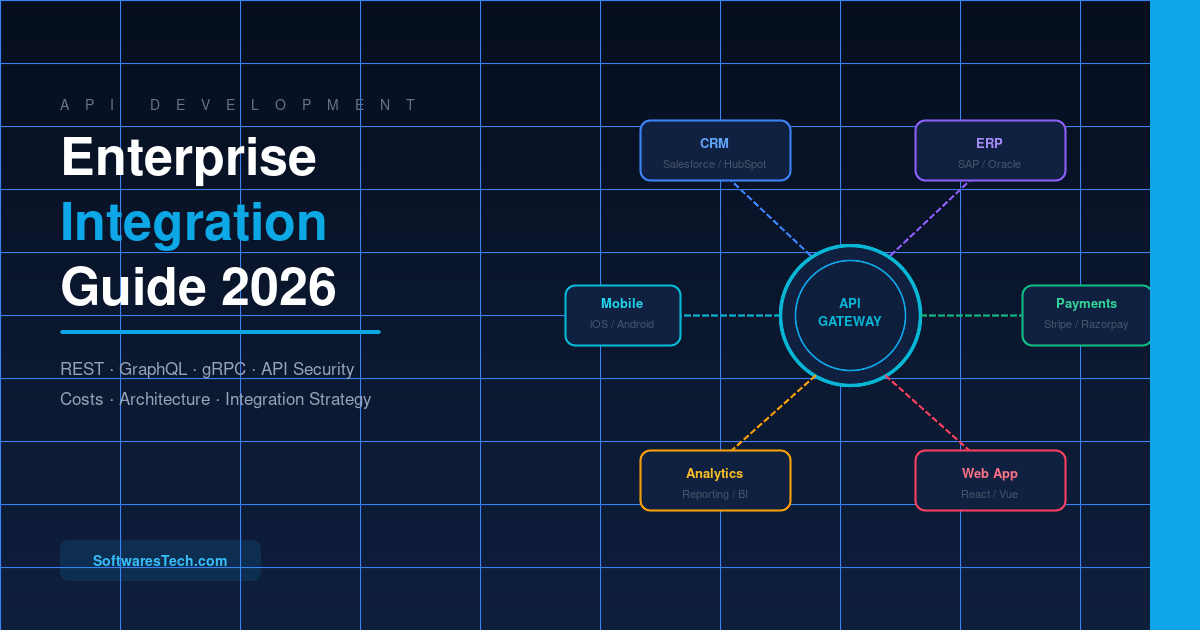
This is the complete guide to API development for businesses — written for CTOs, engineering managers, and business owners who need to make real integration decisions. Below we cover REST vs GraphQL, middleware architecture, security, cost, and what enterprise API projects actually look like in practice.
A logistics company reached out to us 14 months into using five separate software platforms — an ERP for inventory, a separate CRM for customer management, a third-party shipping tool, a custom invoicing system, and a mobile driver app. Each system had been chosen because it was the best tool for its specific job.
The problem was that none of them talked to each other.
Every morning, their operations team exported data from the ERP, manually reformatted it in Excel, and uploaded it into the CRM. The shipping tool required a separate manual entry. The invoicing system ran on a two-day delay because someone had to reconcile the data by hand. The mobile driver app was completely disconnected — drivers logged jobs on paper, and office staff re-entered everything at day end.
They had 18 full-time employees performing work that software should have been doing. When we calculated the real cost — salaries, error rates, delayed invoicing, customer complaints about incorrect shipments — the disconnected systems were costing them roughly £340,000 per year in wasted operational overhead.
The fix was an API integration layer. Not a single new software product. Not replacing their existing tools. Just building the connective tissue between them. Within six months, their operations headcount for data entry dropped from 18 to 4. Invoice processing went from 48-hour delays to real-time. Shipping accuracy improved from 91% to 99.4%. The project paid for itself in under four months.
This is what API development actually does for businesses. It is not a technical luxury. It is the infrastructure that makes modern operations possible.
What API Development Actually Means for Your Business
API stands for Application Programming Interface. But that definition does very little to explain why a CEO or business owner should care about it.
Here is a more useful way to think about it. Every software application your business runs — your CRM, your accounting software, your website, your mobile app, your payment processor — is essentially a locked room full of valuable data and functionality. An API is the door between rooms. It defines exactly what information can pass through, in which direction, under what conditions, and in what format.
When Shopify connects to your accounting software, that is an API doing the work. When a customer completes a payment on your website and automatically receives an email confirmation with order details pulled from your inventory system, that is APIs working in sequence. When your sales team opens your CRM and sees a complete customer purchase history from your e-commerce platform without logging into a second tool, that is API integration.
From a business perspective, APIs solve one fundamental problem: data and functionality locked inside one system cannot create value inside another system without them.
Three categories of APIs relevant to business:
Public APIs — Exposed to the outside world. Other businesses, developers, or partners can use them. Stripe’s payment API is a public API. Google Maps is a public API.
Private APIs — Internal to your organisation. Your systems talk to each other. Your mobile app talks to your backend. Your ERP talks to your warehouse management system.
Partner APIs — Shared with specific external parties under controlled conditions. A manufacturer sharing inventory data with authorised distributors. A healthcare platform sharing patient records with approved clinic partners.
Most enterprises need all three. Startups typically start with private APIs and introduce partner APIs as they scale.
Why Businesses Are Prioritising API-First Architecture
There is a reason the world’s most valuable technology companies — Amazon, Salesforce, Twilio, Stripe — built their entire product strategy around APIs. It is not just about technical elegance. It is about how modern businesses actually scale.
Operational efficiency. Manual data transfer between systems is slow, expensive, and error-prone. APIs eliminate that entirely. When your CRM automatically receives new lead data the moment someone fills out a web form, you are removing a human from a process that does not require human judgment.
Speed to market. Businesses that can plug new tools into their existing stack without custom development every time move significantly faster than competitors who cannot. An API-first architecture means your next software addition is an integration project, not a replacement project.
Revenue generation. Some of the most profitable business moves in recent years have been API-led. A financial services firm that exposes its credit scoring capability as an API to mortgage brokers has created a new revenue stream with near-zero marginal cost. A shipping company that lets e-commerce platforms embed real-time tracking through their API gets locked into thousands of workflows — a powerful competitive advantage.
Scalability without chaos. Monolithic systems — where everything is built into one giant application — eventually become technical debt traps. When one part needs to change, the whole system is at risk. API-driven architectures, particularly microservices, allow individual components to be updated, replaced, or scaled without touching everything else.
Partner and ecosystem development. If you want other businesses to build on top of what you do, you need an API. The entire ecosystem of Shopify apps, Salesforce integrations, and Xero add-ons exists because those platforms made their functionality accessible through documented, well-designed APIs.
Common Problems That Drive Businesses Toward Custom APIs
Most businesses do not arrive at API development because they want it — they arrive at it because something specific broke, slowed down, or became impossibly expensive.
Your systems cannot talk to each other. This is the most common situation. You have accumulated best-of-breed software across departments, and each one operates in isolation. Your team spends hours every week copying data between them. Errors creep in. Decisions get made on outdated information. The pain point is not the software — it may be perfectly good at its job. The pain point is the absence of integration.
A vendor’s native integration is too limited. Many software platforms offer built-in integrations. Salesforce connects to Mailchimp. QuickBooks connects to Shopify. But those native integrations are built for the average use case. The moment your workflow has a non-standard step — a custom approval process, a specific data transformation, a unique validation requirement — you hit a wall. Teams try to work around these limitations through increasingly complicated automation tools. This works up to a point. Beyond that point, it becomes a liability.
You are building a product that needs to work with other products. If you are building a SaaS platform, a B2B tool, or any software that needs to connect with the systems your customers already use, you are in the API development business whether you planned for it or not. Your enterprise customers will ask whether you integrate with Salesforce before they sign a contract. If your product cannot provide these through well-documented APIs, you lose deals.
You need to expose data to partners without exposing your entire system. A pharmaceutical company sharing clinical trial data with research partners. A retailer giving suppliers read-only access to inventory levels. A bank allowing approved fintech applications to read account balances but not initiate transactions. In all of these scenarios, the answer is a purpose-built API with precise access controls.
Your mobile app needs a backend. Every mobile application needs to communicate with a server to store data, authenticate users, process payments, and deliver dynamic content. That communication happens through APIs. If you are building a mobile product, you are building an API whether you realise it or not. The question is only whether it is well-designed or not.
Types of APIs and Which One Your Business Actually Needs
Not all APIs are the same. The architecture pattern you choose has significant implications for development cost, maintenance burden, performance, and long-term scalability.
REST APIs
REST is the most widely used API architecture in the world. It uses standard HTTP methods — GET, POST, PUT, PATCH, DELETE — and typically returns data in JSON format. Almost every developer knows REST. Every major cloud platform supports it. Every client-side technology can consume it.
Best for: Most business applications. Web apps, mobile backends, third-party integrations, public APIs, partner APIs. If you are not sure what you need, REST is almost certainly the right starting point.
GraphQL
GraphQL was developed by Facebook to solve a specific problem: REST APIs often return either too much data or too little, requiring multiple calls to assemble the information a client actually needs. GraphQL lets the client specify exactly what data it wants in a single request.
Best for: Applications with complex, interconnected data models. Front-end teams that need flexibility. Scenarios where bandwidth efficiency matters — particularly mobile clients on variable network conditions.
One mistake we frequently see: teams adopting GraphQL because it sounds modern, then spending twice as long building it because they did not actually have the problem GraphQL solves. REST with thoughtful endpoint design handles most enterprise use cases perfectly well.
gRPC
gRPC is a high-performance RPC framework originally developed by Google. It uses Protocol Buffers instead of JSON, which produces significantly smaller payloads and faster serialisation. It is genuinely faster than REST for server-to-server communication.
Best for: Microservices communicating internally at high volume. Services where latency matters at the millisecond level. Not suitable for browser-based clients without additional tooling.
Webhooks
Webhooks are event-driven HTTP callbacks. Instead of your system asking another system “has anything changed?” on a schedule, webhooks push a notification to your system the moment something happens.
Best for: Real-time notifications. Payment confirmations. Any scenario where polling would create unnecessary load or unacceptable latency.
| Architecture | Speed | Complexity | Browser Friendly | Best Use Case |
|---|---|---|---|---|
| REST | Medium | Low | Yes | Most business applications |
| GraphQL | Medium | Medium | Yes | Complex data, flexible queries |
| gRPC | Very Fast | High | Limited | Internal microservices |
| Webhooks | Real-time | Low | Yes | Event-driven notifications |
| SOAP | Slow | Very High | Limited | Legacy enterprise systems |

Real Business Example: How an API Saved a $2.4M Integration Project
A mid-market retail chain with 140 locations was facing a significant problem. Their legacy point-of-sale system — which had been in operation for eleven years — could not connect to their new e-commerce platform. The e-commerce vendor quoted $2.4M and 18 months to migrate everything to their platform’s native POS system. That was not an integration quote. That was a replacement quote dressed up as an integration quote.
When we were brought in to assess the project, we identified something the original quote missed: the legacy POS system actually had an undocumented internal API — a set of endpoints built for a data warehouse integration that was subsequently abandoned. It had never been formally documented, but it was functional and stable.
What we built instead was a middleware API layer that read sales data from the legacy POS in real-time, transformed and normalised the data format, pushed inventory updates to the e-commerce platform, pulled online order data and queued it for in-store fulfilment, and provided a unified reporting dashboard pulling from both systems.
Total development cost: £180,000. Timeline: 14 weeks. The legacy POS system remained in place. Staff had no retraining requirement. The e-commerce platform got accurate inventory in real-time. The business saved £2.1M and 16 months.
The middleware layer is the key architectural concept. Rather than forcing two incompatible systems to speak directly to each other, you insert a translation layer that each system can communicate with in its own language. Here is what that architecture looked like:
Legacy POS System
      │
      ▼
  Middleware API Layer (custom-built)
  ├── Data normalisation engine
  ├── Conflict resolution logic
  ├── Rate limiting (protected POS from overload)
  └── Audit log (every transaction recorded)
      │
      ├──▶  E-commerce Platform  (REST API push)
      ├──▶  Inventory Management (webhook notifications)
      └──▶  Reporting Dashboard  (read-only GraphQL endpoint)
This is a real pattern, not an unusual outcome. Legacy system replacement is almost always more expensive than integration. The question is whether a clean integration is architecturally feasible — and that requires an experienced assessment, not a replacement quote.

API Architecture: What a Well-Designed System Looks Like
Most businesses that have had a bad API experience had a bad API design experience. The code worked. The endpoints returned data. But the architecture was not built to grow, secure, or maintain.
API Gateway
An API gateway sits in front of all your backend services. It handles routing, authentication, rate limiting, logging, and request transformation in one place rather than implementing those concerns individually in every service. For enterprise systems, the API gateway is not optional — it is the single point of control for who can access what, under what conditions, and at what volume. Without it, you end up with authentication logic scattered across dozens of services.
Versioning
APIs change. The way you handle those changes determines whether you have smooth evolution or catastrophic breaking changes. A URL-versioned API (/v1/orders, /v2/orders) lets you deploy updated logic without breaking existing clients. Version deprecation should have a minimum six-month notice window for external APIs. Making versioning decisions after you have external users is significantly harder than making them before.
Rate Limiting and Throttling
Without rate limiting, a single poorly written client — or a malicious actor — can bring down your entire API with a flood of requests. Rate limiting sets boundaries on how many requests a given client can make per second, minute, or hour. Throttling goes further: rather than rejecting excess requests, it queues them and processes them at a sustainable rate. For business-to-business APIs where clients are performing legitimate bulk operations, throttling often provides a better experience than hard rejections.
Caching
Not every API request needs to hit your database. Product catalog data that changes once a day should be cached aggressively. User account data might cache for 60 seconds. Real-time stock prices should not cache at all. A well-designed API implements caching at multiple levels — at the gateway, at the application layer, and at the database query layer — with appropriate expiry times for each data type. The performance difference between a cached and uncached API can easily be a factor of ten to one hundred.
Circuit Breakers
When one service your API depends on is slow or unavailable, a circuit breaker prevents that failure from cascading through your entire system. Rather than waiting indefinitely for a response that will not come, the circuit breaker opens — fails fast — and returns an appropriate error or a degraded response. For enterprise APIs with multiple backend dependencies, circuit breakers are the difference between a partial outage and a complete system failure.
API Security — The Part Most Vendors Underexplain
API security is where good intentions most frequently fail in practice. Teams that would never hard-code a password in source code will build an API with inadequate authentication because they underestimate how exposed APIs are. In 2025, the OWASP API Security Top 10 remained the leading reference for API vulnerabilities — and the list reads like a description of projects we have been asked to audit and rescue.
Authentication vs Authorisation
These are not the same thing, and confusing them creates serious security gaps.
Authentication answers: Who is this caller? Authorisation answers: What is this caller allowed to do?
A system that authenticates perfectly but authorises poorly — allowing any authenticated user to access any resource — is not secure. We have audited enterprise APIs where valid authentication tokens could access any account simply by changing the account ID in the URL. That is a BOLA (Broken Object Level Authorisation) vulnerability, and it is alarmingly common.
OAuth 2.0 and Token-Based Authentication
For any API accessed by external parties, OAuth 2.0 is the standard. It separates the authentication step (where credentials are verified) from the authorisation step (where tokens scoped to specific permissions are issued). A payment processor API should issue tokens that allow a specific merchant to view their own transaction history. That token should not allow them to view any other merchant’s transactions, and should not allow them to initiate refunds unless they specifically have that permission. Token scoping is where this is enforced.
API Key Management
API keys are simpler than OAuth and appropriate for server-to-server integrations where the calling system is a controlled environment. The mistake is treating API keys as permanent credentials. Keys should have defined expiry dates, be rotated regularly, be revocable without service disruption, be scoped to minimum required permissions, and never appear in client-side code or public repositories.
One incident that illustrates this clearly: a financial services startup had their cloud costs spike from $3,000 to $47,000 in a single month. Investigation revealed that an API key with write access had been committed to a public GitHub repository. Automated bots that scan GitHub for exposed credentials had found it within hours. The key had no expiry, no scope limit, and no monitoring.
Input Validation
Every parameter your API accepts is a potential attack surface. SQL injection, NoSQL injection, command injection, and XML injection attacks all exploit APIs that trust their inputs without validation. The correct approach is a whitelist validation model: define exactly what valid input looks like and reject anything that does not conform. Do not rely on blacklisting known attack patterns — attackers iterate faster than blocklists.
// Reject invalid input at the boundary — never inside business logic
function validateOrderRequest(body) {
  if (!body.customerId || typeof body.customerId !== 'string') {
    throw new ValidationError('customerId must be a non-empty string');
  }
  if (!Number.isInteger(body.quantity) || body.quantity  10000) {
    throw new ValidationError('quantity must be an integer between 1 and 10000');
  }
  if (!ALLOWED_CURRENCIES.includes(body.currency)) {
    throw new ValidationError(`currency must be one of: ${ALLOWED_CURRENCIES.join(', ')}`);
  }
}
What API Development Actually Costs
This is the question every decision-maker eventually asks, and it deserves a direct answer.
API development cost varies enormously based on complexity, security requirements, integration scope, and the team delivering it. The ranges below reflect actual project costs from enterprise engagements — not theoretical estimates.
Key Cost Drivers
Number and complexity of endpoints. A simple CRUD API with ten endpoints is a different scope from a financial transaction API with complex business logic, multi-step workflows, and regulatory compliance requirements.
Security requirements. Public APIs serving third-party developers require significantly more security infrastructure than private internal APIs. PCI DSS compliance for payment APIs, HIPAA for healthcare data, and similar regulatory frameworks add meaningful cost.
Integration complexity. Connecting to a well-documented modern REST API is straightforward. Integrating with a legacy SOAP service, an undocumented internal system, or a vendor API that was clearly designed by someone who disliked developers — that is a different story.
Throughput requirements. An API serving 1,000 requests per day needs different infrastructure than one serving 10 million. High-volume APIs require load testing, performance optimisation, caching architecture, and horizontal scaling considerations from the start.
Documentation and developer experience. If your API will be used by external developers, comprehensive documentation, interactive testing environments, and SDK development add significant effort — and equally significant value.
| Project Type | Complexity | Approximate Cost Range |
|---|---|---|
| Simple internal API | Low | £15,000 – £35,000 |
| Mobile app backend API | Medium | £30,000 – £75,000 |
| B2B partner API | Medium-High | £50,000 – £120,000 |
| Enterprise integration API | High | £80,000 – £250,000 |
| Public API platform | Very High | £150,000 – £500,000+ |
These are development costs. Add ongoing maintenance, hosting infrastructure, monitoring tooling, and security updates — typically 15–20% of initial development cost annually.
Where projects go over budget: Scope creep is the most common cause. APIs that start as “connect our CRM to our ERP” expand mid-project to include real-time syncing, conflict resolution logic, historical data migration, a reporting layer, and a management dashboard. Underestimating legacy system complexity is the second most common cause — legacy systems frequently have undocumented behaviour and inconsistent data that is only discovered during integration work, not during scoping.

Benefits of Custom API Development for Enterprise
Operational automation at scale. Processes that require human intervention because systems do not communicate automatically become automated workflows. Manual data entry, reconciliation, and re-keying are eliminated.
Data accuracy and consistency. When a single change propagates automatically to every system that needs it, data discrepancies between systems disappear. Your sales team, operations team, and finance team are all looking at the same current reality.
Competitive differentiation through ecosystem integration. Businesses that can connect to their customers’ systems — integrating directly into their procurement workflows, their ERP, their analytics tools — become significantly harder to displace than competitors who require manual processes.
Faster product iteration. An API-first architecture decouples your front-end from your back-end. Design teams can prototype new user experiences without waiting for backend changes. Backend teams can improve performance without breaking clients. This decoupling is a meaningful driver of development velocity.
New revenue opportunities. Monetised API access is a legitimate business model. Data you collect as a byproduct of your operations may be genuinely valuable to partners, suppliers, or adjacent businesses — and an API is how you make that value accessible.
Foundation for AI and automation. Every AI-powered feature — personalised recommendations, predictive analytics, automated decision-making — needs access to data through APIs. Businesses that invest in clean, well-structured API layers are building the foundation that makes AI integration tractable rather than a multi-year data project.
Challenges Nobody Warns You About
Versioning debt. As your API evolves, you accumulate versions. Supporting multiple active versions simultaneously is ongoing maintenance cost that compounds with time. The solution is thoughtful versioning strategy from day one — not bolted on after the fact.
API contract management with external partners. When an external partner builds software against your API, you have made an implicit contract about its behaviour. Changing that behaviour — even to fix something that was arguably wrong — breaks their code. Formalising API contracts through OpenAPI specifications and maintaining a clear change communication process are business relationship management requirements, not technical nice-to-haves.
Documentation drift. API documentation that was accurate when written becomes inaccurate as the code evolves. External developers lose trust in your API documentation quickly. Rebuilding that trust is much harder than maintaining it. Automated documentation generation from code reduces drift significantly but does not eliminate it.
The distributed debugging problem. When something breaks in a monolithic application, you look at one log. When something breaks across five microservices communicating through APIs, you need to trace a request through five separate systems. Distributed tracing tooling is essential for production API systems, and it needs to be designed in from the beginning, not retrofitted after your first production incident.
Data consistency across systems. When systems communicate through asynchronous APIs, you introduce the possibility of temporary inconsistency between them. Understanding and designing for eventual consistency versus strong consistency is an architectural decision with significant implications. Getting it wrong in the wrong direction causes either data corruption or unacceptable performance.
Step-by-Step: How to Plan and Build a Business API
Step 1: Define the business problem, not the technical solution. “Connect our CRM to our ERP” is not a problem statement — it is a proposed solution. The problem statement is “our sales team spends 3 hours per day re-entering data that already exists in another system.” That framing changes the scope, priorities, and success criteria.
Step 2: Identify all consumers and their requirements. Every API has consumers — the clients that will call it. Document each type: internal web applications, mobile apps, external partner systems, third-party developers, internal backend services. Designing for one consumer profile and discovering others mid-project is expensive.
Step 3: Design the API contract before building. Define your endpoints, request formats, response structures, error codes, and authentication scheme before implementation begins. Once developers start building against your API, changing the contract is expensive. Contract-first design forces architectural decisions to be made and agreed upon before they are baked into code.
Step 4: Build authentication and authorisation infrastructure first. Security that is retrofitted is security that is incomplete. Authentication and authorisation logic should be the first infrastructure components built — before a single business logic endpoint.
Step 5: Implement logging and monitoring from day one. Every API request should be logged. Every error should be captured with context. Performance metrics — latency, throughput, error rates — should be available in a real-time dashboard from the moment the API goes to production.
Step 6: Build for failure. Every external dependency your API calls can fail. Design your API to handle these conditions gracefully: implement retry logic with exponential backoff, circuit breakers for unreliable dependencies, and sensible timeout values at every layer.
Step 7: Test under realistic conditions. Load tests that reveal your API falls over at 500 concurrent requests — before launch — cost a few days to fix. The same discovery in production costs customers, reputation, and executive confidence.
Step 8: Document before you ship. API documentation is a product deliverable, not a post-launch task. Interactive documentation using Swagger UI or similar tools, authentication guides, code examples in relevant languages, and a changelog are the baseline.
Step 9: Plan for version evolution. Before going live, decide your versioning strategy. How will you communicate breaking changes? What is your deprecation timeline? How long will you support each major version?
Step 10: Establish API governance. For enterprise organisations with multiple teams building and consuming APIs, governance — standards for API design, security requirements, documentation standards — prevents the proliferation of inconsistent, incompatible APIs that creates its own integration problem.

Industry Use Cases
Financial Services
Banking APIs enable embedded finance — the ability for non-financial businesses to offer financial products without becoming banks. Buy-now-pay-later services, expense management tools, and business banking dashboards all depend on financial APIs. For internal enterprise use, financial services firms use APIs to connect trading systems with risk management platforms, compliance monitoring tools, and regulatory reporting systems in real-time.
Healthcare
Healthcare APIs face regulatory complexity that most other industries do not — HIPAA in the United States, NHS data standards in the UK, GDPR across Europe. Practical healthcare API applications include electronic health record integration, remote patient monitoring with IoT medical devices, and appointment scheduling systems that sync across provider networks.
E-Commerce and Retail
The entire e-commerce ecosystem runs on APIs. Payment processing, shipping and logistics, inventory management, warehouse management, returns processing — every component connects through APIs. Retailers building omnichannel experiences require real-time API integration between their digital and physical inventory systems. Getting this wrong means customer disappointment at the till or overselling online.
Manufacturing and Supply Chain
Manufacturer-to-distributor-to-retailer supply chains generate enormous quantities of data — inventory levels, shipment status, quality control results, demand forecasts — that needs to flow between companies in real-time. Modern supply chain integration is migrating from proprietary EDI formats to REST APIs with standardised schemas: faster, cheaper to implement, easier to debug, and compatible with modern analytics tooling.
Professional Services
Law firms, consultancies, and agencies use APIs to connect their billing systems with project management tools, their CRM with proposal software, and their resource planning systems with accounting platforms. The business value of eliminating manual reconciliation between billable hours, project status, and client invoicing is immediate and measurable.
Future Trends in API Development
AI-native APIs. Large language models and AI services are increasingly consumed through APIs — and increasingly helping design and document APIs. Businesses integrating AI capabilities into their products are, by definition, integrating APIs. Beyond consumption of AI services, AI is beginning to assist in API development itself: generating boilerplate code from OpenAPI specifications, automatically identifying security vulnerabilities in API designs, and producing documentation from code.
AsyncAPI and event-driven architecture. REST APIs are synchronous: you make a request and wait for a response. Event-driven architectures are asynchronous: events are published to a message broker, and any interested consumer processes them when it is ready. AsyncAPI is an emerging specification standard for describing event-driven APIs, and as organisations scale their microservices architectures, event-driven patterns are becoming mainstream.
API monetisation platforms. The market for API monetisation — charging for API access, either per-call or through subscription tiers — is maturing. Platforms are making it easier to turn API capabilities into revenue streams without building the billing infrastructure from scratch.
Zero-trust API security. Modern zero-trust architecture assumes nothing — every request, regardless of source, must be authenticated and authorised. As enterprise systems become more distributed, spanning cloud providers, remote workers, and third-party services, zero-trust API security is transitioning from a best-practice recommendation to a baseline requirement.
Tools and Technologies for API Development
The specific tools matter less than how consistently they are applied. This is the core stack we use across enterprise API projects in 2026:


Frequently Asked Questions
What is the difference between an API and a web service?
A web service is a specific type of API that communicates over HTTP/HTTPS. In business software contexts, “API” and “web service” are often used interchangeably to mean HTTP-based APIs, which is accurate enough for practical purposes.
How long does it take to build a business API?
A simple internal API connecting two existing systems can be built in four to eight weeks. A public API platform with comprehensive documentation and production-grade infrastructure typically takes four to nine months. The complexity of business logic, security requirements, and integration scope are the primary variables.
Do I need a custom API if I can use Zapier or Make?
Integration platforms like Zapier and Make are excellent for connecting common business tools through pre-built connectors without development work. They break down when your workflow requires custom business logic, high transaction volumes, real-time performance, or integration with systems that do not have pre-built connectors. A practical rule: if your Zapier setup has more than ten steps and requires significant data transformation, a custom API will be more reliable and cost-effective long-term.
Can APIs work with our legacy systems?
In most cases yes. Some legacy systems have internal APIs or database interfaces that can be wrapped in a modern REST layer. Others require a middleware adapter that translates between modern API calls and the legacy system’s native communication method. Genuine exceptions exist but are less common than vendors suggest when proposing replacement projects.
What does API development cost for a business?
API development costs range from £15,000 for simple internal APIs to £500,000+ for comprehensive public API platforms. Mobile app backend APIs typically cost £30,000–£75,000. Enterprise integration APIs with complex security and compliance requirements range from £80,000–£250,000.
What security certifications should an API development partner have?
For most business APIs, look for demonstrated experience with OAuth 2.0 implementation, OWASP API Security Top 10 awareness, and TLS certificate management. For regulated industries, confirm specific compliance experience: PCI DSS for payment processing, HIPAA for healthcare data, ISO 27001 for general information security.
What happens when a third-party API we depend on changes?
This is a real operational risk. Mitigation strategies include abstracting third-party API calls behind your own internal interface, subscribing to vendor change notifications, and maintaining test environments that run against staging versions of external APIs. Including third-party API stability in vendor selection criteria also reduces this risk.
How do we know if our API is performing well?
The key metrics are: request volume, latency at the 95th and 99th percentile (these matter more than average for user experience), error rate as a percentage of total requests, and availability percentage. Setting alerting thresholds and having a process for responding to alerts is part of operating a production API.
Conclusion
There is a version of this guide that ends with a list of reasons to call us. That is not the version you got.
What you got instead is what we actually believe: that most businesses can evaluate their API needs clearly if they understand the right questions to ask. Do your systems communicate efficiently, or does human labour bridge gaps that software should bridge? Are you losing integration deals to competitors who can connect to enterprise procurement systems? Are your teams making decisions on data that is hours or days out of date?
If the answer to any of those questions involves a wince, you are living with an integration problem. Whether that problem is solved by a well-configured off-the-shelf integration tool, a targeted custom API, or a comprehensive API platform depends entirely on your specific situation.
What we have learned across hundreds of enterprise software engagements is that the cost of addressing this properly — with appropriate architecture, security, and documentation — is almost always less than the accumulated cost of working around it. Manual processes, error correction, delayed reporting, and failed integration deals have a price. It is just distributed invisibly across your organisation rather than appearing on a single invoice.
The right first step is an honest technical assessment: map what your systems need to share, quantify what manual workarounds are currently costing, and identify where integration would change what is possible for your customers and your team. The architecture follows from the requirements. The requirements follow from the business problem. Start there.
Need Help with API Development?
Building a production-grade API — one that is secure, well-documented, performant, and built for long-term maintainability — requires both technical depth and practical experience with real enterprise integration challenges. Softwarestech’s custom software development and IT consulting services work with businesses from startups to large enterprises to design and build APIs that actually solve the operational problems they were built for. If your organisation is evaluating an API project, reach out and we can help you scope it accurately from the start.
Further Reading
- Microservices Architecture: API Design Patterns
- Custom Software Development Guide
- API Security: Cybersecurity Essentials 2026
For industry benchmarks and additional context, we recommend the OpenAPI Specification.
Need Help Building Your Next Digital Product?
From web and mobile apps to cloud infrastructure and AI-powered platforms — our engineers can help you plan, build and scale with confidence.
Related Articles
Microservices Architecture: The Complete Engineering Guide for 2026
A complete, practical guide to microservices architecture — covering service communication, data management, security, Kubernetes deployment, observability and real-world migration patterns for 2026.

Custom Software Development: The Complete Business and Technical Guide for 2026
Everything you need to know about custom software development in 2026 — from discovery and architecture to security, DevOps, and ROI. A practical guide for business owners, CTOs, and engineering teams.
Modern Software Development Lifecycle (SDLC) Guide for 2026
How the six SDLC phases are evolving in 2026, with practical guidance on methodologies, AI-assisted coding, architecture choices, and testing.