

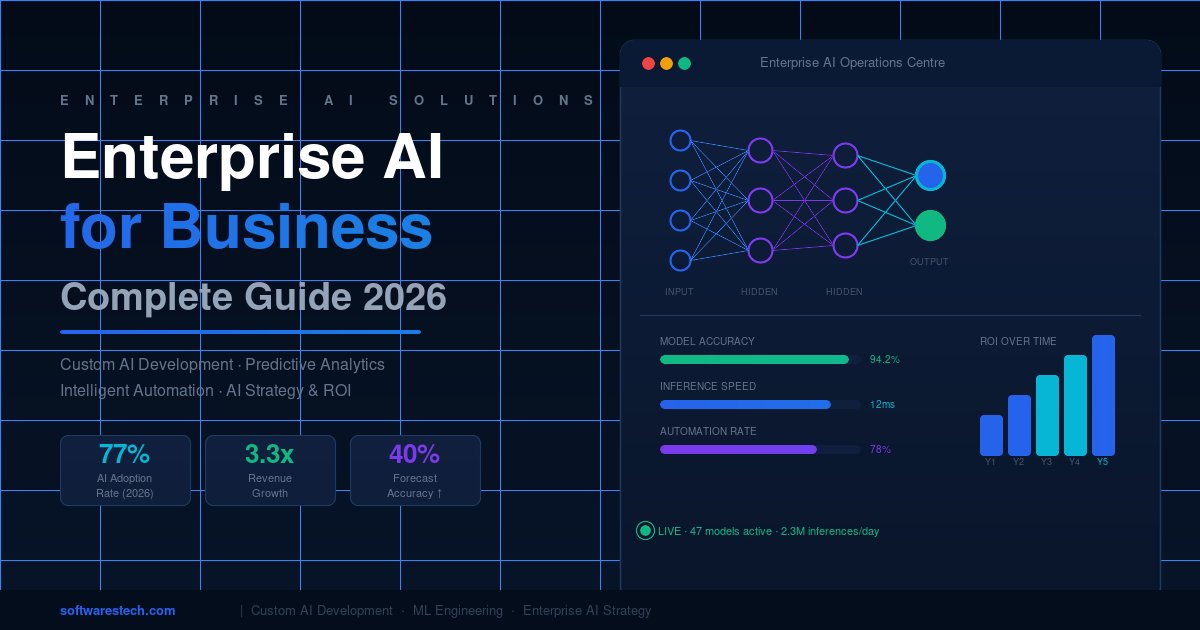
Enterprise AI solutions are reshaping how businesses compete — but most implementations fail before they deliver value. A mid-sized logistics firm in Ohio spent $2.1 million on an AI initiative over 18 months. At the end of it, the system was never deployed to production. The models were trained on the wrong data. The vendor promised an off-the-shelf solution that required so much customisation it became unrecognisable. The internal team lacked the expertise to evaluate what they were buying. And nobody had defined what success actually looked like before the contract was signed.
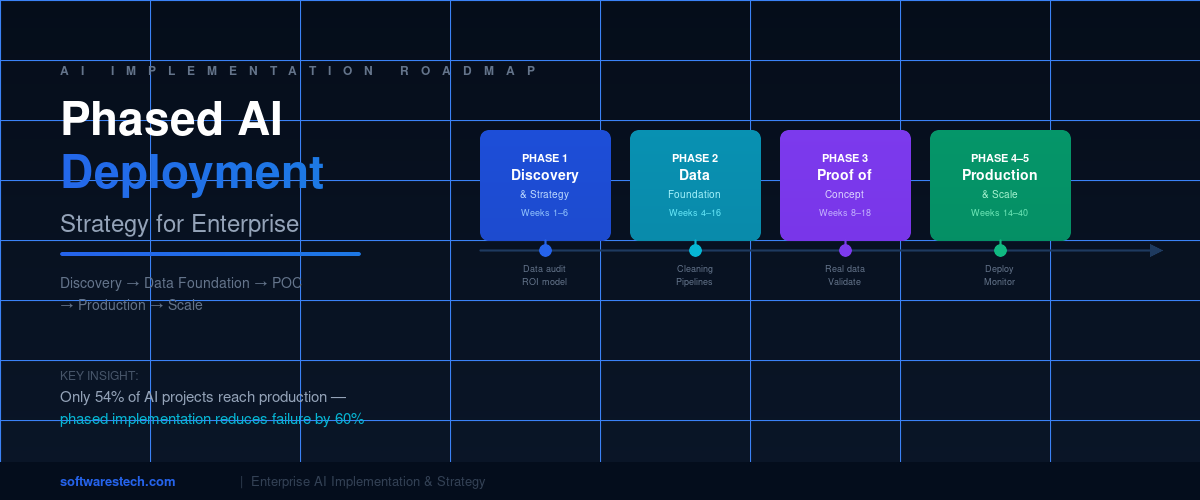
They are not unusual. According to McKinsey, only 54% of AI projects make it from pilot to production. The gap between enterprise AI ambition and enterprise AI reality is largely not a technology problem. It is an implementation problem, a strategy problem, and a vendor-selection problem.
This guide is for business owners, CTOs, and IT leaders who want to understand enterprise AI solutions from the ground up — what they are, how they actually work inside real organisations, what they cost, and how to build or buy them without ending up as a cautionary tale.
What Are Enterprise AI Solutions?
Enterprise AI solutions are artificial intelligence systems built or deployed specifically to address business-scale operational, analytical, or customer-facing challenges. The word “enterprise” carries real meaning here. It means the system must handle volume, complexity, security requirements, and integration demands that consumer AI products are simply not designed for.
A chatbot you build for your website is not an enterprise AI solution. A natural language processing system that reads 40,000 incoming customer support tickets per day, classifies them by urgency and type, routes them to the correct department, drafts suggested responses for agents, and continuously improves based on agent feedback — that is an enterprise AI solution.
Enterprise AI typically encompasses several functional categories:
- Predictive analytics and forecasting — demand forecasting, churn prediction, financial modelling
- Intelligent process automation — document processing, data extraction, workflow orchestration
- Natural language processing (NLP) — customer support automation, contract analysis, knowledge management
- Computer vision — quality inspection, document scanning, security monitoring
- Recommendation systems — personalisation engines, product suggestions, content optimisation
- Anomaly detection — fraud prevention, network security, operational fault detection
- Generative AI integration — code generation, content creation, synthetic data, internal copilots
Most enterprise organisations need several of these capabilities working together, not in isolation.
The State of Enterprise AI in 2026: What the Numbers Say
The gap between AI adoption rhetoric and ground-level reality has narrowed significantly in the past two years, but it still exists. Here is the actual landscape:
- IBM’s Global AI Adoption Index reports that 77% of enterprise organisations are either actively deploying AI or exploring it
- McKinsey estimates that AI adoption has more than doubled since 2017, yet only 21% of AI-aware companies have deployed AI at scale across multiple functions
- Gartner predicts that by the end of 2026, 80% of enterprises will have used generative AI APIs or deployed applications built on them
- The average enterprise AI investment in 2025 ranged from $500,000 to $5 million for a single mature production system
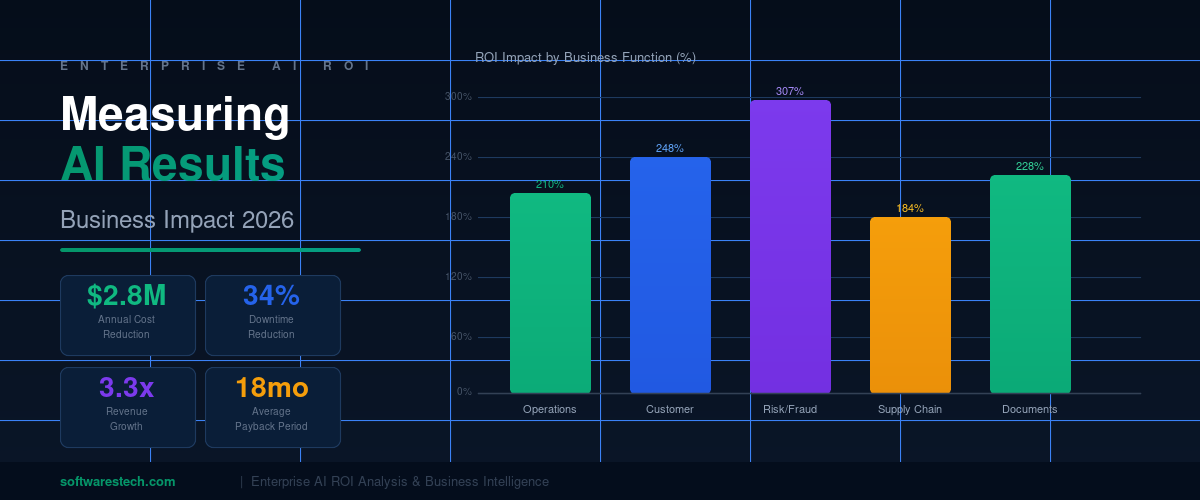
- Companies that have scaled AI across five or more functions report 3.3x higher revenue growth than those with limited AI use
The businesses winning with AI in 2026 share a pattern: they started with a specific operational problem, not a technology ambition. They built or bought AI to solve something measurable. They invested in data infrastructure before model training. And they chose partners who understood their industry, not just the algorithms.
Build vs Buy vs Customise: The Core Decision Every Enterprise Faces
Before evaluating any vendor or writing any technical specification, you need to resolve the fundamental question: should your organisation build custom AI software, buy an existing platform, or take a third path — customising a foundation model or an existing vendor product?
Each path has a different cost structure, risk profile, and capability ceiling.
Buying an Off-the-Shelf AI Platform
Platforms like Salesforce Einstein, Microsoft Azure AI Services, IBM Watson, and Google Vertex AI offer pre-built AI capabilities that can be activated within weeks. The appeal is speed and lower upfront investment.
The hidden cost is fit. These platforms are built for generalised use cases. If your operations are in any way non-standard — which enterprise operations almost always are — you spend significant time and money configuring something that was not designed for your situation. You also become deeply dependent on the vendor’s pricing, roadmap, and data policies.
Best for: Standard use cases at speed. CRM AI features, general sentiment analysis, off-the-shelf document processing for common document types.
Building Custom AI Software
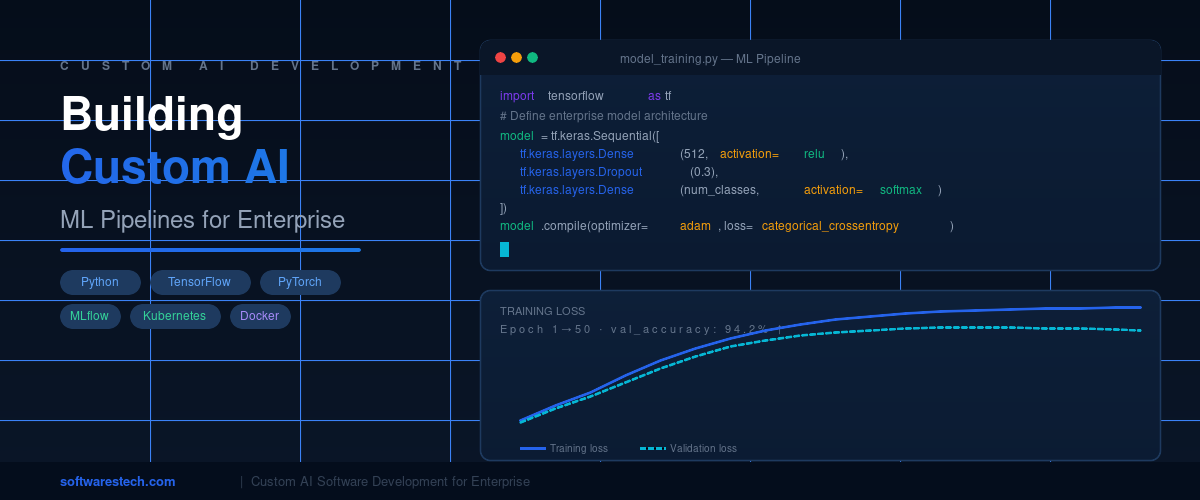
Custom AI development means working with an AI development company or internal team to build models and systems designed specifically for your data, your processes, and your goals. Training is done on your proprietary data. Architecture is designed around your infrastructure. The system does exactly what your business needs it to do.
Cost is higher upfront. Timeline is longer. But the performance ceiling is far higher, the competitive advantage is real (your competitor cannot buy the same system), and total cost of ownership over three to five years often undercuts platform licensing fees.
Best for: Proprietary use cases, organisations with unique data, high-volume operations where performance improvements translate directly to revenue or cost reduction.
Customising Foundation Models
The emergence of large language models (GPT-4, Claude, Gemini, Llama) and open-source alternatives has created a third path. Fine-tuning or building on top of these foundation models allows organisations to get the capabilities of a sophisticated AI system while significantly reducing the training data and infrastructure investment required.
This approach works well for language-intensive use cases: contract review, knowledge base Q&A, internal copilots, customer communication drafting. It is less suitable for numerical prediction tasks, computer vision, or highly domain-specific classification problems where proprietary training data is the actual competitive asset.
Best for: Language-heavy workflows, internal knowledge management, organisations with limited proprietary training data but clear use cases.
Decision Framework
| Factor | Buy Off-the-Shelf | Build Custom | Customise Foundation Model |
|---|---|---|---|
| Time to first value | 2–8 weeks | 4–12 months | 6–16 weeks |
| Upfront cost | Low–Medium | High | Medium |
| 3-year TCO | High (licensing) | Medium–Low | Medium |
| Competitive moat | None | High | Moderate |
| Data privacy control | Limited | Full | Variable |
| Performance ceiling | Fixed | Unlimited | High |
| Vendor dependency | High | None | Moderate |
The Most Effective Enterprise AI Use Cases in 2026
Not all AI use cases are equal. The ones generating proven, measurable ROI at enterprise scale share common traits: they are data-rich, they involve repeatable processes, the output is measurable, and the cost of errors is meaningful enough that improvement translates directly to dollars.
1. Intelligent Document Processing
Enterprises process enormous volumes of unstructured documents: invoices, contracts, insurance claims, medical records, legal filings, purchase orders, compliance documents. Manual processing is slow, expensive, and error-prone.
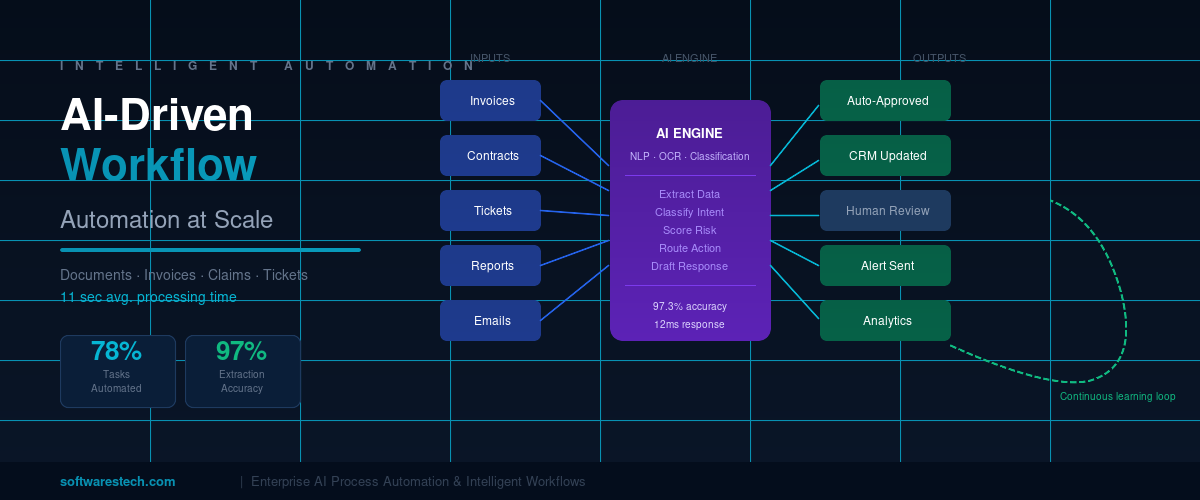
AI-powered document processing systems use OCR, NLP, and custom trained classifiers to extract structured data from unstructured documents automatically. A financial services company we worked with processed 12,000 loan application documents per week manually. After building a custom document intelligence system, processing time dropped from 4 minutes per document to 11 seconds per document, with 97.3% extraction accuracy. The operational saving was $2.8 million annually.
2. Demand Forecasting and Supply Chain Optimisation
Manufacturers and retailers have used statistical forecasting for decades. AI-driven forecasting adds the ability to process thousands of input variables simultaneously — historical sales, promotional calendars, weather, economic indicators, competitor pricing signals, social sentiment — and produce forecasts that are consistently 15–40% more accurate than traditional statistical models.
The compounding effect of a 1% improvement in forecast accuracy at enterprise scale is significant. For a retailer carrying $500 million in inventory, a 5% improvement in forecast accuracy translates to roughly $12–18 million in inventory reduction and stockout prevention combined.
3. Customer Experience Personalisation
Recommendation engines, dynamic pricing, personalised content delivery, and behavioural segmentation are well-understood applications. What has changed in 2026 is that this is no longer exclusively Amazon’s or Netflix’s capability. B2B companies, healthcare providers, and financial services firms are deploying personalisation AI at scale for the first time, driven by the reduction in custom AI development costs.
4. Predictive Maintenance
Industrial enterprises operating physical assets — manufacturing equipment, fleets, infrastructure — have found predictive maintenance to be among the highest-ROI AI applications available. Sensor data from IoT-connected equipment, processed through anomaly detection and failure prediction models, allows maintenance teams to intervene before failures occur rather than after.
Downtime is consistently the highest-cost operational event in industrial settings. A cement manufacturer reported that deploying predictive maintenance AI across its 14 plants reduced unplanned downtime by 34% and extended equipment lifespan by an average of 18%.
5. Fraud Detection and Risk Management
Financial services, insurance, and e-commerce companies have deployed AI fraud detection systems that process transactions in real time, scoring risk using hundreds of behavioural and contextual signals simultaneously. The accuracy advantage over rule-based systems is substantial: fewer false positives (which damage customer experience), and the ability to detect novel fraud patterns as they emerge rather than only matching known historical patterns.
6. Intelligent Customer Support Automation
Beyond generic chatbots, enterprise-grade conversational AI systems now handle complex multi-step customer interactions: billing disputes, insurance claims, technical troubleshooting, appointment scheduling with contextual reasoning across customer history. The best implementations are not trying to eliminate human agents — they are enabling agents to handle more complex work by handling the straightforward volume automatically.
What Custom AI Software Actually Costs in 2026
Enterprise AI investment ranges vary widely, and vendors are frequently opaque about realistic cost structures. Here is an honest breakdown based on current market rates.
Discovery and Strategy Phase
Before writing a single line of code, a rigorous AI engagement should include data audit, use case prioritisation, feasibility analysis, architecture design, and ROI modelling.
Cost range: $15,000 – $60,000
Timeline: 4–8 weeks
Data Infrastructure and Preparation
The most underestimated cost in AI projects. Real production AI requires clean, labelled, consistently structured training data. For most enterprises, data quality work — cleaning, labelling, pipeline construction — represents 30–50% of total project cost.
Cost range: $30,000 – $250,000+
Timeline: 6–20 weeks
Model Development and Training
Designing model architecture, training, evaluation, hyperparameter tuning, and validation.
Cost range: $50,000 – $400,000
Timeline: 8–24 weeks
Integration and Deployment
Building APIs, connecting to existing enterprise systems, creating monitoring infrastructure, deploying to production.
Cost range: $40,000 – $200,000
Timeline: 6–16 weeks
Ongoing Operations (Year 1)
Model monitoring, retraining, infrastructure costs, support.
Cost range: $60,000 – $300,000 per year
Total First-Year Investment by Project Scale
| Project Scale | Description | Typical Investment |
|---|---|---|
| Proof of Concept | Single use case, limited data scope | $40,000 – $120,000 |
| Single Production System | One fully deployed AI capability | $150,000 – $600,000 |
| Multi-System Platform | Multiple AI capabilities with shared infrastructure | $500,000 – $2,500,000 |
| Enterprise AI Programme | Organisation-wide AI strategy and deployment | $1,000,000 – $10,000,000+ |
How to Choose the Right AI Development Company
The vendor selection decision is where most failed AI projects begin to go wrong. The market is crowded with firms that market “AI capabilities” but are, in practice, reselling cloud APIs with a services wrapper. Here is how to separate genuine capability from marketing noise.
What to Look For
Domain experience, not just AI experience. An AI company that has never worked in your industry will spend months learning things your team already knows. Domain-trained AI also performs materially better than generic models because the training data and evaluation criteria reflect real operational context.
Proprietary model development capability. Ask directly: do they train their own models, or do they wrap existing APIs? There is nothing wrong with using foundation models intelligently, but you need to know which is happening and why.
MLOps and post-deployment support. A model that performs well in testing will drift in production. Every AI system requires monitoring, retraining, and ongoing management. If a vendor does not have a structured post-deployment programme, your system will degrade.
Data handling and security posture. Enterprise AI handles sensitive data. Verify where training data is processed, how models are stored, what compliance certifications they hold (SOC 2, ISO 27001, GDPR compliance for EU data), and what data stays within your infrastructure versus theirs.
Reference clients in your scale range. A vendor that has only delivered projects for five-person startups is not equipped to handle enterprise complexity. Ask for references at comparable project scale and complexity.
Red Flags to Watch For
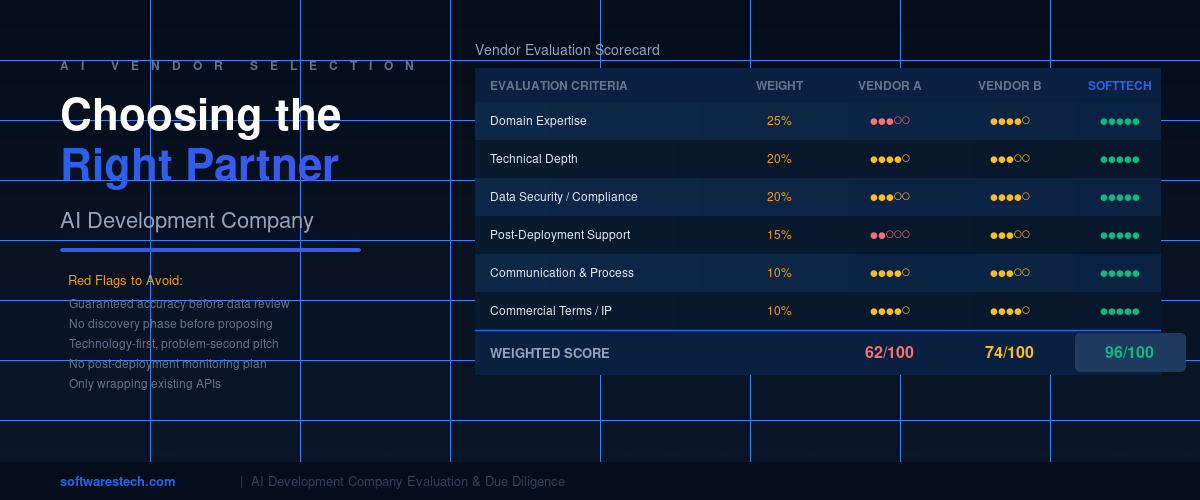
- Guaranteed accuracy metrics before seeing your data
- Fixed-price contracts on ill-defined scopes
- No discovery or data audit phase before proposing a solution
- Inability to explain model decisions in plain business terms
- No clear ownership of model monitoring post-deployment
- Proposal that leads with technology rather than your business problem
- Team that cannot name the specific algorithms they would use and why
Evaluation Criteria Scoring Matrix
| Criteria | Weight | What to Assess |
|---|---|---|
| Domain expertise | 25% | Relevant industry deployments, case studies |
| Technical depth | 20% | Proprietary model capability, MLOps maturity |
| Data handling / security | 20% | Certifications, data architecture, GDPR/HIPAA |
| Post-deployment support | 15% | Monitoring programme, SLA, retraining process |
| Communication and process | 10% | Reporting cadence, stakeholder management |
| Commercial terms | 10% | Pricing structure, IP ownership, exit terms |
Enterprise AI Implementation: A Phased Roadmap
Successful enterprise AI programmes share a common implementation structure. Here is the phase-by-phase process that consistently delivers production-grade results.
Phase 1: Discovery and Alignment (Weeks 1–6)
Objectives: Identify the highest-value AI opportunities, validate data readiness, align stakeholders, establish success metrics.
Key activities:
- Business process audit to identify automation and optimisation opportunities
- Data inventory: what data exists, in what format, at what quality level
- Use case prioritisation using value vs effort matrix
- Baseline measurement of current process performance
- Stakeholder alignment on success definition and project governance
- Risk and compliance assessment
Output: Prioritised AI roadmap with clear business cases, ROI projections, and phased investment plan.
Phase 2: Data Foundation (Weeks 4–16)
AI is only as good as the data it learns from. This phase is the most frequently underinvested in enterprise AI programmes, and the most common reason for project failure.
Key activities:
- Data quality assessment and cleaning
- Data labelling for supervised learning use cases
- Data pipeline engineering for ongoing data ingestion
- Feature engineering (identifying which data inputs drive predictive value)
- Data governance policy implementation
Phase 3: Proof of Concept (Weeks 8–18)
Build a working prototype on a constrained scope. Not a demo. Not a slide deck. A system that runs on real data and produces outputs that can be evaluated against real business criteria.
The goal is not to impress a boardroom. It is to learn whether the approach works, identify technical challenges early, and validate assumptions before committing full investment.
Phase 4: Production Development (Weeks 14–32)
Build the production-grade system: scalable architecture, security hardening, integration with existing enterprise systems, monitoring and alerting infrastructure, human oversight workflows where needed.
Enterprise AI systems that go directly to production without a proper POC phase have failure rates significantly higher than those that do not.
Phase 5: Deployment and Change Management (Weeks 28–40)
Technical deployment is straightforward compared to the human side of AI rollout. Users need training. Processes need redesigning around the new capability. Trust needs to be built gradually. Feedback mechanisms need to be in place.
Organisations that invest in change management during AI deployment report 2.6x higher adoption rates than those that treat deployment as purely a technical activity.
Phase 6: Monitoring, Optimisation, and Scaling (Ongoing)
A deployed AI model is not finished. It is a living system. Data distributions shift. Business conditions change. Model performance drifts. The post-deployment phase requires structured monitoring and alerting, scheduled retraining, performance reviews, and a roadmap for expanding capabilities.
Common Mistakes That Kill Enterprise AI Projects
After reviewing dozens of failed AI programmes, the same patterns repeat. Avoiding these is as important as following best practices.
Starting with technology, not a problem. “We want to implement AI” is not a project brief. “We want to reduce customer churn in our enterprise SaaS product from 18% annually to below 12% over 24 months using predictive intervention” is a project brief.
Ignoring data quality. Eighty percent of AI project work is data work. Executives who approve AI budgets based on model development costs alone consistently underestimate total investment.
Treating AI as a one-time deployment. AI systems that are not maintained degrade. A demand forecasting model trained on 2022 data and never updated will perform progressively worse as market conditions change. Budget for maintenance from day one.
Skipping the POC phase. The pressure to show results fast pushes many organisations straight from concept to full production build. The POC phase exists to surface the technical and data problems that are always cheaper to resolve before full development begins.
Building without a data owner. AI systems require a designated internal owner who understands the data, can evaluate model outputs for business sense, and can manage the relationship with the AI development team over time. The absence of this role is a reliable predictor of post-deployment neglect.
Underestimating integration complexity. An AI model that produces accurate predictions but cannot connect to the systems where those predictions need to act has zero business value. Integration architecture must be designed at the start, not retrofitted at the end.
Building Internal AI Capability vs. Relying on Partners
Most enterprises in 2026 operate in a hybrid model: a small internal AI team defines strategy, manages vendor relationships, and owns deployment and monitoring, while external AI development partners handle the heavy model development work that would be uneconomical to staff internally.
A fully internal AI capability requires data scientists, ML engineers, data engineers, and MLOps specialists. At US market rates, a functional team of six costs $1.8–$2.4 million annually in salaries before overheads. For organisations running fewer than three to four concurrent AI workstreams, this investment rarely makes sense.
The hybrid approach — two to four internal staff who own strategy and partnerships, backed by a capable AI development company for execution — delivers enterprise-grade AI outcomes at significantly lower total cost than either fully internal or fully outsourced models.
Data Privacy, Compliance, and AI Governance
Enterprise AI operating in regulated industries faces a compliance landscape that is evolving faster than most organisations can track.
The EU AI Act, which comes into full enforcement in 2026, classifies AI systems by risk level and applies corresponding obligations. High-risk applications — AI in HR decisions, credit scoring, medical diagnosis support, critical infrastructure management — face mandatory conformity assessments, transparency requirements, and human oversight obligations.
In the United States, the FTC has issued guidance on algorithmic accountability, and sector-specific regulators (OCC, SEC, FDA) have each issued AI-specific guidance for their domains.
The practical implications for enterprise AI programmes:
- Build explainability requirements into AI system design from the start, not as an afterthought
- Maintain audit trails for all model decisions in high-stakes applications
- Implement bias testing protocols for any AI touching hiring, lending, or healthcare decisions
- Ensure data processing agreements with AI vendors cover your regulatory obligations
- Appoint an AI governance owner at the senior leadership level
The Future of Enterprise AI: What Is Coming in the Next 24 Months
The trajectory is clear even if the timing is uncertain. These are the developments that will materially change enterprise AI capability in the next two years:
Multimodal AI at enterprise scale. Systems that simultaneously process text, images, structured data, and audio are moving from research demonstrations to production deployment. The implications for document processing, customer service, and inspection applications are significant.
Agentic AI systems. AI agents that do not just respond to queries but plan, take actions, use tools, and complete multi-step business processes autonomously are moving into early enterprise deployment. Automating complex workflows that today require human judgment at each step.
On-premise large language models. Open-source models (Llama, Mistral, and their successors) running on enterprise-owned infrastructure are closing the capability gap with closed API models. For industries with strict data residency requirements, this changes the economics of generative AI deployment fundamentally.
AI-to-AI orchestration. Enterprises will increasingly run multiple specialised AI systems that pass work between each other. A customer query might be classified by one model, have context retrieved by a second, drafted by a third, and reviewed for compliance by a fourth — all within seconds.
Regulation driving standardisation. The EU AI Act and its international equivalents will push enterprise AI teams toward standardised documentation, testing, and monitoring practices. This will increase upfront compliance costs but reduce long-term governance risk.
Key Takeaways
- Enterprise AI solutions deliver measurable ROI when built around specific, measurable business problems — not technology ambition
- 54% of AI projects fail to reach production; the gap is strategic and implementation failure, not technology failure
- Build vs buy vs customise decisions should be made on competitive moat, data uniqueness, and three-year TCO — not just upfront cost
- Data quality is the single most underinvested element of enterprise AI programmes
- Vendor selection must evaluate domain expertise, post-deployment support, and data security — not just model accuracy claims
- Phased implementation with a genuine POC consistently outperforms direct-to-production approaches
- Hybrid internal/external AI teams deliver the best outcome for most enterprises at current market conditions
- Governance and compliance requirements are non-negotiable and must be designed in, not retrofitted
Conclusion
Enterprise AI in 2026 is neither the limitless transformation its proponents promised nor the overhyped distraction its sceptics claimed. It is a set of powerful, maturing technologies that deliver real and significant business value when implemented with disciplined strategy, clean data, and the right partners.
The companies building durable competitive advantages through AI are not necessarily the ones with the largest AI budgets. They are the ones who started with clear business problems, invested in their data foundations, chose experienced partners, and committed to the ongoing work of maintaining and improving their systems.
The window for early-mover advantage is still open. But it is narrowing. Enterprises that have already deployed AI in core operations are building training data moats and operational learning curves that will become harder to close over time.
The question is no longer whether your organisation should invest in enterprise AI. The question is whether you are investing in it strategically enough to win.
Ready to Build Enterprise AI That Actually Delivers?
Softwarestech builds production-grade custom AI solutions for enterprises in manufacturing, financial services, healthcare, retail, and technology. From AI strategy and data architecture to model development, integration, and ongoing optimisation — we cover the full lifecycle.
Our AI engineering team has delivered predictive analytics, intelligent automation, NLP systems, and computer vision applications across four continents. We work with your data, your infrastructure, and your timelines.
Frequently Asked Questions
What is an enterprise AI solution?
An enterprise AI solution is an artificial intelligence system designed specifically for business-scale operations. It handles the volume, security, integration, and compliance requirements that consumer AI tools cannot. Enterprise AI solutions include predictive analytics platforms, intelligent process automation, custom NLP systems, computer vision applications, and recommendation engines deployed at organisational scale.
How much does it cost to build custom AI software for an enterprise?
Enterprise AI development costs range from $40,000 for a focused proof of concept to $2.5 million or more for a multi-system production platform. The largest cost driver is typically data preparation, which accounts for 30–50% of total project investment. Annual maintenance and monitoring adds 20–30% of initial development cost per year.
How long does enterprise AI implementation take?
A single production AI system takes 6–12 months from discovery to deployment for most enterprise use cases. Organisations with well-structured, clean data can move faster. Those requiring significant data engineering and labelling work typically take longer. Rushing the data foundation phase is the most reliable predictor of post-deployment failure.
What is the ROI of enterprise AI solutions?
Well-designed enterprise AI programmes generate ROI through four levers: cost reduction (automation of manual processes), revenue uplift (personalisation and churn prevention), risk reduction (fraud detection, compliance automation), and quality improvement (defect detection, forecasting accuracy). McKinsey reports that companies scaling AI across five or more business functions show 3.3x higher revenue growth than those with limited AI use.
Should we build custom AI software or buy an off-the-shelf AI platform?
Off-the-shelf platforms are faster to deploy but carry higher long-term licensing costs and are limited to generic use cases. Custom AI software delivers competitive advantages through proprietary model training on your data, and typically shows lower total cost of ownership over three to five years. The right answer depends on whether your use case is standard or proprietary, and whether differentiation matters competitively.
How do we choose the right AI development company?
Evaluate AI development companies on five factors: domain expertise in your industry, genuine model development capability (not just API wrapping), post-deployment monitoring and maintenance programmes, data security and compliance certifications, and reference clients at comparable project scale. Avoid vendors who quote guaranteed accuracy before seeing your data or who lead proposals with technology rather than your business problem.
What data do we need before starting an enterprise AI project?
The required data depends heavily on the use case. As a general rule, supervised machine learning systems require labelled examples numbering in the thousands to tens of thousands. Predictive models require historical data spanning multiple business cycles. The more critical questions are data quality, consistency, and completeness — volume alone does not guarantee a trainable dataset.
Is generative AI suitable for enterprise use in 2026?
Yes, with appropriate scoping. Generative AI is most effective for language-intensive enterprise workflows: document summarisation, contract review, internal knowledge management, customer communication drafting, code generation, and synthetic data creation. It is less suitable for precise numerical prediction or tasks requiring guaranteed factual accuracy without human review. Enterprise deployment requires data privacy controls, output quality monitoring, and clear human oversight protocols.
How do we measure the success of an enterprise AI project?
Define success metrics before development begins, not after deployment. Effective metrics are specific, measurable, and tied to real business outcomes: reduction in processing time per transaction, improvement in forecast accuracy as measured against baseline, decrease in fraud loss rate as a percentage of revenue, reduction in customer churn in the target segment. Avoid metrics like “model accuracy” in isolation — a model can be highly accurate on test data and irrelevant to business performance.
What are the biggest risks in enterprise AI projects?
The primary risks are: poor data quality undermining model performance, scope creep extending timelines and costs, vendor capability mismatch, lack of internal ownership post-deployment, regulatory non-compliance in high-risk application areas, and model drift after deployment without a monitoring and retraining programme. Risk mitigation centres on rigorous discovery, a genuine POC phase, clear governance, and structured post-deployment maintenance.
How does enterprise AI handle data privacy and regulatory compliance?
Enterprise AI compliance requires designing privacy and governance requirements into the system architecture from the start. This includes data residency controls, model explainability for high-stakes decisions, bias testing protocols, audit trail maintenance, and data processing agreements with all AI vendors. In the EU, the AI Act introduces risk-based classification and mandatory conformity assessments for high-risk applications. Compliance must be scoped as a project requirement, not a post-deployment consideration.
What industries benefit most from enterprise AI solutions?
Financial services (fraud detection, credit risk, algorithmic trading), healthcare (clinical decision support, medical imaging, patient flow optimisation), manufacturing (predictive maintenance, quality inspection, demand forecasting), retail and e-commerce (personalisation, inventory optimisation, pricing), logistics (route optimisation, capacity planning), and professional services (document processing, contract analysis, knowledge management) consistently show the highest measurable ROI from enterprise AI deployment.
Can small and mid-sized businesses implement enterprise AI solutions?
Yes. The cost of enterprise AI has dropped significantly in the past three years. Smaller businesses can access foundation model capabilities through API integrations at moderate cost, or target specific high-value use cases with focused custom development rather than broad AI programmes. The key constraint is usually data quality and volume rather than budget alone. A mid-sized business with clean operational data and a well-defined problem can build an effective AI system for $60,000–$200,000.
What is the difference between AI and machine learning in an enterprise context?
Artificial intelligence is the broad field. Machine learning is the primary technical approach used in most enterprise AI applications today — systems that learn patterns from data rather than following manually written rules. When an enterprise vendor references AI solutions, they typically mean systems built on machine learning, deep learning, natural language processing, or computer vision techniques, all of which fall under the machine learning branch of AI.
How do we build internal AI capability as an enterprise?
Most enterprises should target a hybrid model: build a small internal team of two to four people who own AI strategy, vendor relationships, and data governance, while partnering with a specialist AI development company for model development and infrastructure. Full internal capability requires data scientists, ML engineers, data engineers, and MLOps specialists — a team of six costs $1.8–$2.4 million annually at US rates and only makes financial sense for organisations running multiple concurrent large-scale AI programmes.
Need Help Building Your Next Digital Product?
From web and mobile apps to cloud infrastructure and AI-powered platforms — our engineers can help you plan, build and scale with confidence.
Related Articles
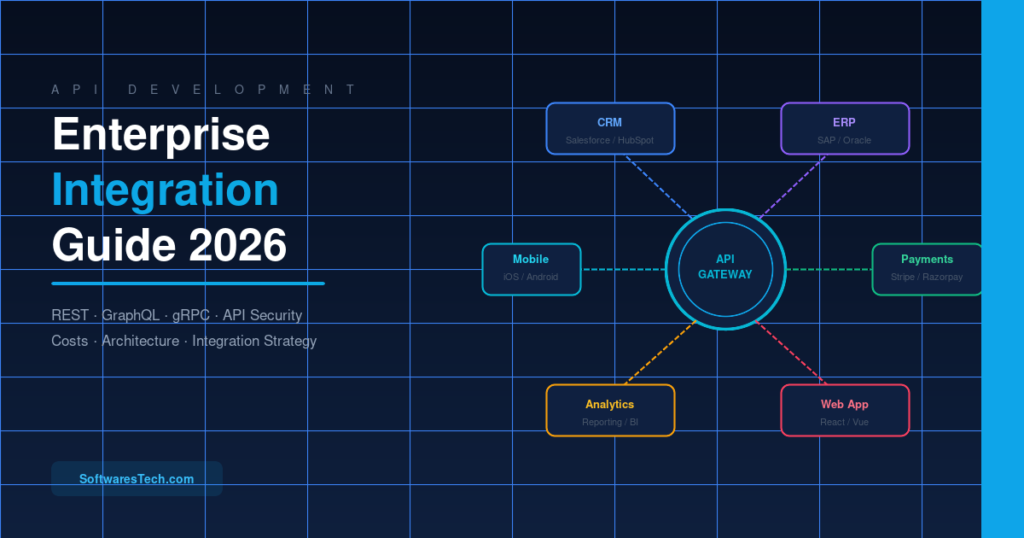
API Development for Businesses: The Complete Enterprise Integration Guide (2026)
This is the complete guide to API development for businesses — written for CTOs, engineering managers, and business owners who need to make real...

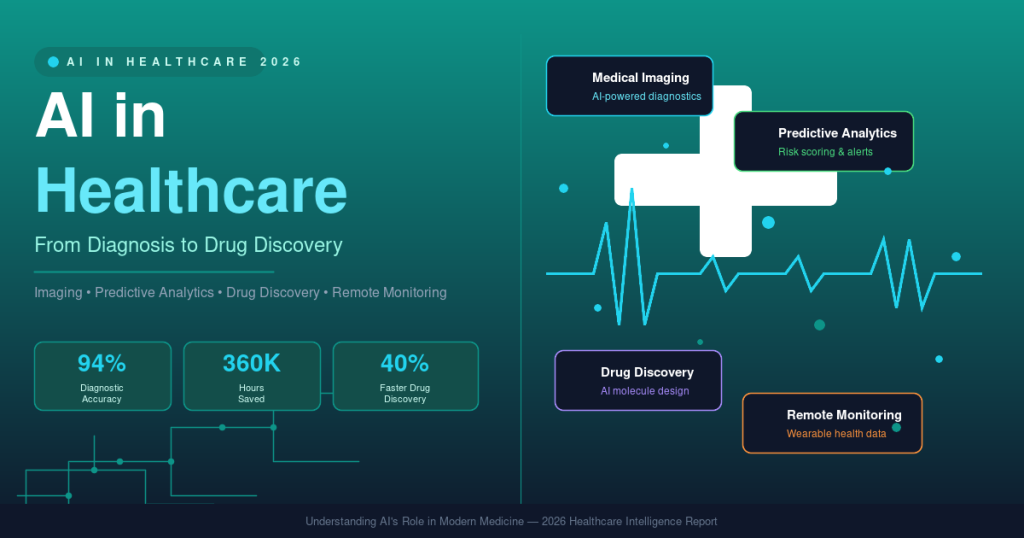
How AI is Transforming Healthcare in 2026: Real Applications, Risks and What Comes Next
Discover how AI is reshaping healthcare in 2026 — from early diagnosis to drug discovery. Real use cases, implementation strategies, challenges and expert insights.
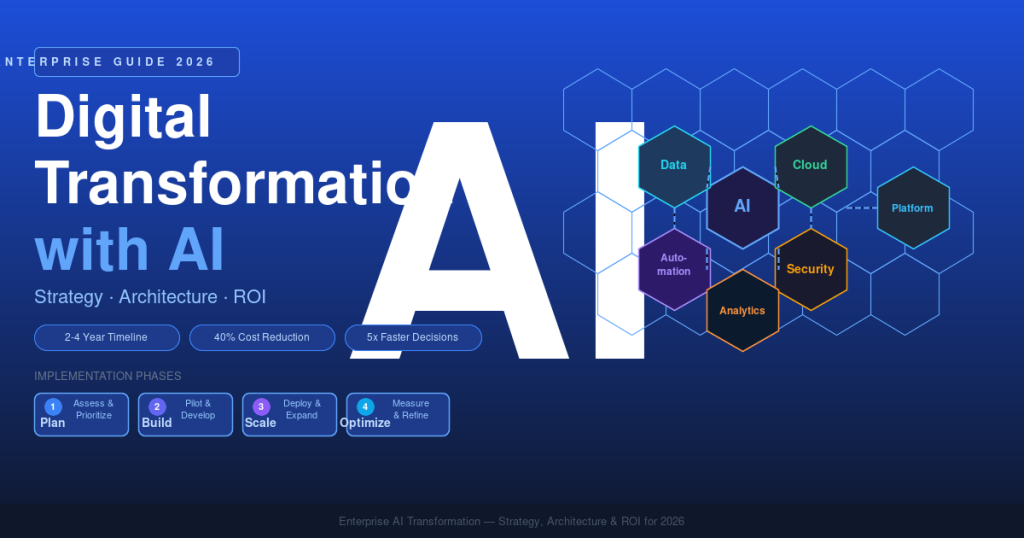
Digital Transformation with AI in 2026: The Complete Enterprise Guide
Discover how AI is redefining digital transformation in 2026. Real implementation strategies, enterprise use cases, ROI frameworks, and expert advice for CTOs, business leaders and digital transformation teams.